
Separate Venue Labels from What They Prove
The guide explains how the informal term relates to gaming venues and where licensing, access, reviews and online-play claims have limits.

What “Pokies Parlour” Means in Australia
In Australia, “pokies parlour” is an informal phrase, not a separate class of casino licence. “Pokies” is local shorthand for gaming machines, while “parlour” can suggest a room or venue where they are available. Put together, the words may describe a physical gaming area, but they do not, by themselves, tell you whether the place is a casino, a club, a hotel or another kind of gaming venue.
That distinction matters because a casino is not defined simply by its machines or by the word used to describe it. Australian casinos operate under licences issued by the state or territory responsible for the property. The local jurisdiction sets the regulatory framework for that casino. So when a business calls itself a parlour, the label alone does not establish that it is a licensed casino or identify what kind of venue it is.
A physical casino is a real-world property operating within that jurisdictional system. Australia’s major casinos operate around the clock, although that does not mean every service or part of a property is necessarily available at every moment. The venue exists independently of how it is described in a directory, advertisement or conversation. Its legal status comes from its relevant authorisation, not from a familiar-sounding name.
If you’re looking for a pokies parlour casino in Australia in 2026, check the available payment and licensing details before deciding where to play. This list gives you a concise reference to the information provided for each operator.
-
Ricky Casino
- Payout speed
- crypto under 1 hour, PayID 1-3 business days
- Min. deposit
- A$20 (A$30 to qualify for the bonus)
Ricky Casino lists crypto payouts in under an hour and PayID payouts in 1–3 business days. The minimum deposit is A$20, or A$30 to qualify for the bonus.
-
Wild Tokyo
- License
- Curacao
- Payout speed
- crypto 30-60 minutes, fiat 1-5 days
- Min. deposit
- A$10
Wild Tokyo lists a Curaçao licence and a minimum deposit of A$10. Its stated payout times are 30–60 minutes for crypto and 1–5 days for fiat.
-
Neospin
- License
- Curacao Gaming Control Board OGL/2023/176/0095 (Hollycorn N.V.)
Neospin is listed with a Curaçao Gaming Control Board licence, OGL/2023/176/0095, held by Hollycorn N.V.
-
Bizzo Casino
- License
- Curacao Gaming Control Board (TechSolutions Group N.V.)
Bizzo Casino is listed with a Curaçao Gaming Control Board licence held by TechSolutions Group N.V.
-
Golden Pokies
- License
- Curacao
Golden Pokies is listed with a Curaçao licence. No further operator details are provided here.
-
Thor Casino
- License
- Curacao – Antillephone N.V. (Versus Odds B.V.)
- Min. deposit
- EUR 20
Thor Casino is listed with a Curaçao licence through Antillephone N.V. (Versus Odds B.V.). Its stated minimum deposit is EUR 20.
-
SpinsUp
- License
- Curacao Gaming Control Board OGL/2023/174/0082 (Dama N.V.)
SpinsUp is listed with a Curaçao Gaming Control Board licence, OGL/2023/174/0082, held by Dama N.V.
-
Lucky Dreams
- License
- Curacao
- Min. deposit
- A$20 (POLi)
Lucky Dreams is listed with a Curaçao licence. Its stated minimum deposit is A$20 when using POLi.
-
House of Pokies
- License
- international iGaming licence – jurisdiction not named in the source
- Payout speed
- PayID 1-24 hours
- Min. deposit
- A$30 (PayID from A$10)
House of Pokies lists an international iGaming licence, though the jurisdiction is not named. Its stated PayID payout time is 1–24 hours, and the minimum PayID deposit is A$10, with A$30 also listed as the minimum deposit.
-
MrPacho
- Payout speed
- crypto 30-120 minutes, fiat 24-72 hours
- Min. deposit
- A$30
MrPacho lists crypto payouts in 30–120 minutes and fiat payouts in 24–72 hours. The minimum deposit is A$30.
The phrase can also be used loosely in writing about Australian casinos. A specialist review, for instance, describes more than 20 full-scale casinos across the country’s eight states. That is a statement from that kind of publication, not a timeless definition of what counts as a casino. The number of properties and the way they are classified can change, while the word “parlour” still does not settle the question of licensing.
The key contrast is with an online site that uses similar wording. A website may call itself a “pokies parlour” or a “parlour casino”, but that does not make it a physical Australian casino. Nor does the appearance of Australian themes, local language or casino imagery establish that the site is authorised to provide its services here. A name can describe a brand or a marketing concept; it cannot substitute for the legal status of the service.
That is especially important because the law treats online casino-style gambling differently from land-based casinos. The Interactive Gambling Act 2001 prohibits operators from providing real-money online casino games to people physically in Australia. The prohibition covers casino-style services such as slots, poker and table games. A website using the word “casino” or “pokies” therefore should not be read as evidence that it is an online version of a locally licensed physical venue.
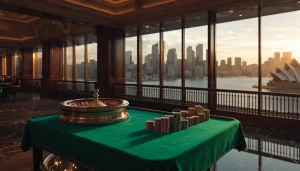
It helps to keep three ideas separate. “Pokies” is a colloquial term. “Parlour” is a loose description that may refer to a room or a venue. “Casino” can refer to a physical property licensed by a state or territory, but online branding does not confer that status. Mixing the terms together can make a search result sound more official than the underlying evidence warrants.
The same caution applies when a website appears to have Australian-facing content. A domain that loads, a page that accepts account traffic or a change to a different web address does not establish that the operator holds an Australian casino licence. Those details describe access or presentation, not authorisation. They should not be treated as a bridge between a physical casino and an online service.
For a reader trying to understand the phrase, the useful starting point is therefore its context. In conversation about a building, “pokies parlour” may be an informal way to refer to a gaming area or venue. In a casino directory, it may be a broad label rather than a precise regulatory category. On a website, it may simply be part of the brand’s wording. The phrase is not enough to tell you which meaning applies.
This distinction also prevents a common category error: assuming that because a physical casino is regulated in Australia, any site borrowing casino language is regulated in the same way. Land-based licensing belongs to the relevant state or territory and applies to the licensed property. Online casino-style services are subject to a different federal boundary. Similar wording does not make the two interchangeable.
So, “pokies parlour” is best understood as informal language rather than a dependable legal description. When the term refers to a real venue, the venue’s identity and local licensing context matter. When it appears online, the wording alone says little about the service’s status in Australia. The name may be familiar; the distinction behind it is not merely a matter of vocabulary.
Where Gambling and Casinos Are Located
Gambling venues are not concentrated in one part of Australia. A specialist gambling-industry review counted gambling in 147 Australian cities, a figure that describes the spread of activity across urban areas rather than a count of casinos alone. The category is broader than casinos: a city may have gambling facilities without having a full-scale casino. The distinction matters when you compare national coverage with the number of casino properties.
The same review identified Sydney, in New South Wales, as the country’s largest gambling city, counting 11 gambling facilities there. That is a city-level tally, not a claim that Sydney has 11 casinos. It also reflects the review’s way of classifying and counting facilities; it should not be read as a permanent official register. The number of venues, their status and the boundaries used for a city-level count can change, so the figure is most useful as a snapshot of how one specialist review described the distribution.

The Northern Territory offers a more focused example. A specialist gambling-industry review counted three casinos across three cities in the Territory. In that account, Alice Springs had the highest city-level casino count, at one. Since the Territory-wide figure is three casinos in three cities, the stated maximum is modest: the review does not describe a single urban centre holding several casinos. It instead presents casino locations as spread across separate places.
These figures answer different questions. The national city count concerns places where gambling facilities were identified; Sydney’s figure concerns facilities in one city; and the Northern Territory count is specifically about casinos. Treating them as interchangeable would blur the difference between a broad gambling map and a casino-only tally. A listing of cities with gambling does not, by itself, show how many casinos operate in each one, while a casino count does not measure all gambling facilities nearby.
For someone trying to understand where a physical venue might be, the figures are an orientation rather than a directory. They suggest that gambling activity is geographically widespread and that Sydney stands out in the cited city-level comparison, while the Northern Territory’s casinos are distributed among three cities. They do not establish that every listed city has a casino, or that every facility counted offers the same services. Those details need to be checked at the venue level.
The safest reading is therefore specific: a specialist review reported gambling activity in 147 cities, counted 11 gambling facilities in Sydney, and described three casinos in three Northern Territory cities, with Alice Springs at one. These are attributed snapshots, not timeless totals. For location decisions, the distinction between casinos and other gambling venues is as important as the map itself.
Sydney, NSW
Identified as the country's largest gambling city with 11 gambling facilities.
Northern Territory
Contains three casinos spread across three different cities.
Alice Springs, NT
Holds the highest city-level casino count in the Northern Territory, with one venue.
Casino Locations and Practical Access Details
For a visit to a land-based casino, the venue’s location is only part of the practical picture. Entry requirements apply across Australia: you must be at least 18 to enter a casino, and major Australian casinos require valid photo identification. A VIP label or invitation does not replace those basic requirements.
Lasseters Casino is at 93 Barrett Drive, Alice Springs, in the Northern Territory. That full address identifies the venue’s street location for anyone planning a visit. Check your route against the address before setting out, particularly if you are unfamiliar with Alice Springs.
Jupiters Gold Coast Casino & Hotel is on Broadbeach Island on the Gold Coast.
Country Club Casino is on Country Club Avenue in Prospect, within Meander Valley. The locality is useful when distinguishing the venue from other places that may share the Country Club name.
Before travelling, make sure you have valid photo ID available and meet the age requirement. Entry-age rules are nationwide, while the listed location details help distinguish the venues themselves. A request for VIP treatment should not be mistaken for a different entry age or an exemption from identification requirements.
What Casino Reviews Can—and Cannot—Confirm
A review using “pokies parlour” may describe a physical gaming venue, an online service using similar wording, or both. Those are different subjects. Before relying on a review, identify what it actually assessed: a visit to a named venue, information published by a website, or an online account and its features. A page title or familiar phrase alone does not establish which kind of service is being discussed.

For a physical venue, a useful review makes clear what the writer observed and what came from other sources. Details such as location or entry arrangements can be checked against the venue’s own published information. Opinions about atmosphere or service remain opinions, even when they are confidently stated. A review should not be treated as a current confirmation if it gives no indication of when its details were checked.
Online reviews need a different test. A site may load, accept account activity or move to another web address, but none of those facts proves that it is licensed to offer online casino gambling in Australia. A functioning page is evidence only that the page could be reached at that moment. It does not establish who operates it, what local permission it holds, or whether its service is lawful for people in Australia.
Domain changes can make this distinction harder to see. When a web address stops resolving through an Australian internet provider, another address may later appear. That change can reflect the effect of blocking on which addresses are reachable; it does not, by itself, show that the operator has gained approval or that the new address is safe. Nor does an old review become reliable simply because a replacement domain looks similar.
Regulatory enforcement records describe ACMA blocking illegal gambling services, including alternate domains connected with Fair Go. That history is relevant when assessing claims that a service has returned under a new address. It is not proof that every site using a similar name is connected to the same operator, and it does not establish that a particular address is authorised. Treat the connection as a matter to verify, not an assumption.
Do
- Check if the review identifies the specific service or venue
- Distinguish direct observations from copied claims
- Verify access and licensing via regulatory records
Don't
- Assume a functioning page proves legal authorisation
- Trust a replacement domain as evidence of approval
- Rely on a review's tone as proof of licensing
Look closely at what a review supports. Does it identify the service or venue being discussed? Does it distinguish direct observation from claims copied from a site? Are the statements about access, ownership and licensing backed by separate evidence? A page that repeats an operator’s assurances without showing how they were checked offers little basis for a conclusion. Reader comments may help identify disputed experiences, but they do not establish licensing either.
The key limit is simple: reviews can help you understand what a writer says they encountered, and they can point to claims that deserve scrutiny. They cannot turn accessibility, a changed domain or a polished presentation into proof of Australian authorisation. For that, the evidence must come from the relevant regulatory record—not from the review’s tone or the site’s ability to open.
Online Play: The Australian Regulatory Boundary
The federal rules draw a clear line between a casino’s physical gaming floor and casino-style gambling provided online to people in Australia. Under the Interactive Gambling Act 2001, operators cannot provide real-money online casino games to customers who are physically in the country. The prohibition covers slots, poker and table games, including familiar formats such as blackjack and roulette. Calling a service a “parlour” or presenting it as a casino does not change the nature of the activity covered by the law.

The Australian Communications and Media Authority (ACMA) is the federal regulator responsible for enforcing the Act and monitoring compliance with federal interactive gambling laws. Its role includes investigating services that provide prohibited online gambling or advertise it to people in Australia, and taking enforcement action where appropriate. This is a federal framework; it does not create a local licence for an online casino to serve Australian customers.
One enforcement tool is website blocking. ACMA can ask Australian internet service providers to block access to websites that provide prohibited interactive gambling services or advertise them in Australia. Blocking is an enforcement measure, not a ruling that every site that remains accessible is lawful. Nor does a change of web address, by itself, alter the underlying legal position. The regulator’s concern is the service and its conduct, rather than the wording used to present it.
ACMA reports that, following enforcement actions, it has blocked more than 1,455 illegal gambling and affiliate websites since November 2019. That total indicates the scale of blocking activity over the stated period; it is not a count of licensed operators or a guarantee that every prohibited service has disappeared. Websites and addresses can change, so a particular result may not describe the status of the broader service.
There is also a discrepancy in published withdrawal totals. One reported figure says more than 210 illegal services have left the Australian market since ACMA began enforcing the rules in 2017. Another version gives a lower figure: over 190 services since 2017. Those figures do not match, so neither should be treated as an uncontested count. Both describe reported withdrawals following enforcement, rather than a number of sites that can be assumed to remain available or unavailable today.
Legal Prohibition
Under the Interactive Gambling Act 2001, it is prohibited for operators to provide real-money online casino games to people physically located in Australia.
The distinction matters when a service is presented as offering online casino play, including play described as free. A label alone does not establish whether the service involves real-money gambling, and it cannot override the rules that apply to prohibited services. The relevant legal boundary concerns what an operator provides to people in Australia and whether it advertises a prohibited service here. ACMA can investigate and act when an operator provides or advertises such services.
The Act’s penalties are directed at those who breach the law: the stated maximum daily penalty is $360,000 for an individual and $1.8 million for a body corporate. These figures describe potential operator-side penalties, not the price of access to a service or a measure of its legitimacy. For a reader, the essential point is that online casino-style gambling is not made lawful for Australians by an accessible website, a different domain, or a claim that the service is a parlour.
Sign-Up Bonuses and Deposits: What This Guide Can Verify
A sign-up bonus is an inducement presented to someone opening an account; a no-deposit offer is described as available without an initial deposit. The wording can make these offers sound straightforward, but a headline does not establish what a person would actually receive, what conditions would apply or whether the service may lawfully be offered in Australia.
Treating an advertised phrase as a settled offer would go beyond what can be established.

A bonus label is not a set of terms
A promotion may be described as a welcome bonus or as a reward requiring no deposit. Those labels alone do not explain the full arrangement. A reader would need to know what the offer requires, who qualifies, whether it is available to people in Australia, and what conditions govern any claimed benefit. Without those details, the label is not enough to compare offers or decide whether an offer is usable.
The same caution applies to language suggesting that no deposit is needed. It does not, by itself, show that there are no other requirements, restrictions or conditions. Nor does it establish that an offer is genuine, current or available to a particular person. An appealing headline is a claim, not proof of its own terms.
A polished promotion can still leave important questions unanswered; the small print is where a claim would have to become specific.
Deposit wording needs context
A reference to deposits may appear alongside a bonus claim, but it should not be read as confirmation that a deposit is required, accepted or sufficient to qualify. The wording could refer to a condition, a payment process or a general account claim; without reliable terms, the meaning cannot be pinned down.
A reader should not make a payment decision on the strength of a banner, a short description or a promise that omits its conditions.
There is a more important boundary than the wording of any promotion. Under the Interactive Gambling Act 2001, operators cannot provide real-money online casino games to people physically located in Australia. Casino-style online games are prohibited services in this context. A bonus claim does not alter that legal position, and describing an offer does not make it permissible.
What to do with an offer claim
If a page advertises a sign-up reward or a no-deposit benefit, separate the claim from what it actually establishes. Ask what the offer says about eligibility and conditions, whether those terms are clear, and whether the service is legally permitted to serve people in Australia. A website being accessible or displaying account-related material does not establish Australian licensing; a promotion cannot supply that proof either.
This is not a recommendation to pursue an offer or to test whether it works. It is a way to avoid mistaking promotional language for confirmed terms. If the details are unclear, do not fill the gaps with assumptions about the amount, qualifying action, deposit or withdrawal. If the claim cannot be understood from its stated conditions, it cannot support a sound decision.
The distinction matters especially when the wording promises something for signing up or says that no deposit is needed. Neither phrase resolves the questions that matter: what is being offered, under what conditions, and whether the service can lawfully make that offer to someone in Australia. Without clear, reliable answers, the headline remains only a claim.
Free Chips and Spins: No Verified Offer Details
“Free chips”, “free spins” and “free play” sound specific, but the labels alone do not tell you what is actually being offered. They may appear in a headline, a banner or a page title without explaining who can use the offer, where it applies or what the word “free” means in practice. Treat the wording as a claim to be checked, not as proof that an offer is available.
A meaningful description would identify the service or venue making the claim and set out the relevant conditions in plain language. It would also distinguish a promotional phrase from access to a particular game or facility. Without those details, you cannot tell whether the claim refers to an Australian land-based venue, an online service, or simply a page using familiar casino language.
The distinction matters because “free” does not automatically mean unrestricted or without conditions. A label by itself does not establish eligibility, the way any play works, or whether other requirements apply. Nor does it establish that the advertised service is authorised to provide the activity to people in Australia. A polished page, an account prompt or a welcoming message cannot fill in those gaps.
For online casino-style play, there is a further boundary: Australian law prohibits operators from providing real-money casino games to people located in Australia. A claim involving free play does not, on its own, alter the legal status of an online casino service. The wording should not be treated as a safe route into a service whose underlying activity is prohibited.
If you encounter an offer claim, look for a complete explanation rather than relying on a short label. The wording should make clear what is being offered, who is responsible for it and which conditions govern access. If those points are absent, the claim gives you too little information to make a reliable decision. Do not infer that chips, spins or play are available simply because the page uses those terms.
Free-play language can also blur the difference between entertainment and gambling-related promotion. The word “free” may draw attention away from the service behind it, while a prominent button may invite you to proceed before the details are clear. Pause before sharing personal information or opening an account. A page’s appearance or accessibility is not proof of Australian authorisation, and an offer label is not a substitute for clear terms.
The practical answer is straightforward: a reference to free chips, spins or play is not enough to establish an actual offer or its conditions. Unless the claim explains what applies and who stands behind it, you have no sound basis for assuming that anything is available to you. This is especially important when the wording appears beside online casino games, which Australian law treats as prohibited when supplied to customers in Australia.
Bonus Claims and the Limits of the Available Evidence
A broad claim about a pokies parlour bonus does not tell you whether an offer is actually available or what it involves. The phrase can appear beside a venue name, on a page using similar branding, or in promotional copy, but the wording alone is not proof of a particular benefit.

That distinction matters because “bonus” is not a complete set of terms. To assess a concrete claim, you would need to know who is making it, what the offer provides, who can qualify, what action is required, and what conditions apply before anything can be claimed or used. Without those details, a headline cannot establish the value or practical effect of an offer. Nor does a familiar name or logo settle who stands behind the claim.
Treat broad wording as an invitation to check the actual terms, not as a promise. Look for an identifiable operator and a clear set of conditions tied to the specific offer. If those details are absent, unclear or inconsistent across pages, you cannot reliably infer what a person would receive or have to do. Avoid filling those gaps with assumptions based on another venue, an older promotion or a similarly named website.
Those labels can sound interchangeable in promotional copy, but each would require its own terms before it could be assessed. A claim that merely uses the word “bonus” should not be treated as confirmation of any of them.
You may also encounter a bonus claim presented as if it were a standing feature of a venue. That presentation still needs support from current, attributable terms. A general description does not show when an offer applies, whether it is limited to particular customers, or whether conditions change what the headline appears to promise. Where the details cannot be established, the careful reading is simply that the claim is unsubstantiated—not that an offer exists by implication.
The useful conclusion is modest: a bonus label can describe a marketing claim, but it cannot replace the terms that would make that claim specific. Without a substantiated offer and its conditions, there is no sound basis for comparing it with another claim or treating it as something you can obtain.
Parlour Pokies and Casino Machine Numbers
The national count of gaming machines installed in Australian casinos is 3,308. These machines are also commonly called pokies, including when people use “parlour” to refer to a casino setting. The figure is an aggregate: it describes machines across casino venues, not the number at any single property.
The count has a specific scope. It covers machines installed in casinos and endorsed on venue licences. It should not be read as a count of every gaming machine in Australia, or as a measure of machines in pubs, clubs or other types of gaming venue. Nor does it indicate how many machines a visitor will find at a particular casino.
A national total cannot show how machines are distributed between venues. It does not establish that each casino has the same number, and it gives no detail about the models or games available. Those details would need to be confirmed for an individual venue rather than inferred from the countrywide figure.
The wording also matters: “installed” and “endorsed on venue licences” describe the basis of this count. It is not a measure of how many machines are in use at a given moment, how often they are played or how much people spend on them. The number is useful as a national snapshot of licensed casino machine stock, but it cannot answer venue-specific questions by itself.
For someone trying to understand what “parlour pokies” refers to, the count provides scale, not a directory or a description of the experience at a particular casino. A broad national total may sound precise—and 3,308 is precise as a count—but it says little about any one venue.

Real-Money Casino Searches and What They Establish
A page describing a “pokies parlour” as a real-money online casino may look like a venue listing, but the wording does not make it a physical Australian casino. Nor does a polished site, an account page or a payment option establish that the service is authorised to offer online casino play in Australia.
The legal distinction is important. Under the Interactive Gambling Act 2001, operators may not provide real-money online casino games to people physically located in Australia. That includes slots, poker and table games. The restriction concerns the operator’s service; it does not turn an online casino into a licensed Australian venue merely because its website loads or accepts account activity.
A claim of Australian approval needs to be treated accordingly. There is no Australian licence for an online casino to provide those prohibited real-money games to local customers. A foreign licence, a claimed approval from another jurisdiction or a local-sounding brand does not change that boundary. If a site uses “real money” to describe casino-style play for people in Australia, that phrase is a description of what it claims to offer, not proof that the offer is lawful or locally licensed.
Domain changes do not settle the question either. A website can move to another address or remain accessible while its regulatory status remains unchanged. Likewise, search placement, user reviews and the ability to create an account are not evidence of Australian authorisation. Each is a feature of how a site appears or operates, not proof of permission under Australian law.
For a reader comparing a physical parlour with an online real-money offer, the safest distinction is straightforward: a search result identifies a claim, not a legal status. Do not treat “real money” wording, an alternate web address or an accessible account page as confirmation that online casino play is authorised in Australia.